
In recent years, the value placed on high school extracurriculars has become more intentional. Admissions offices are no longer just looking for well-rounded students; they are looking for "angular" students—those who have chosen to delve deeper into a specific, authentic passion project rather than joining every club available to them. As a result, a growing number of students are pursuing independent research projects to demonstrate intellectual curiosity, academic scholarship, and a willingness to go beyond the standard school curriculum.
When it comes to conducting a research project, families generally find themselves evaluating two distinct pathways: independent research (often via self-directed study or cold emailing university professors) or a structured, one-on-one research mentorship program like Polygence. Both paths can lead to incredibly meaningful outcomes, a standout college portfolio, and professional growth. However, the right choice depends heavily on your child’s goals, learning style, research experience, and the level of support they need to see the project through.
Why More High School Students Are Pursuing Research Opportunities
The rising interest in high school research isn't just a passing trend. For students who desire an intellectual challenge, standard AP or IB courses can sometimes feel like an exercise in memorization rather than honest exploration. Research gives students the rare opportunity to zoom in on a highly specific topic they actually care about—whether that is K-Pop’s psychological influence on its fanbase, using machine learning for early detection of disease, or a deep dive into the environmental impact of the California wildfires.
Naturally, this type of academic exploration and research experience has become a major discussion point in college applications and admissions. When an admissions officer reads an essay about a student's original research project—what they did, how they did it, and its significance—they see someone who is already operating at a collegiate level.
But as more families recognize this, they face an immediate question: How do we actually get started? Do we attempt to undergo the complex real-world of academic research at top universities independently, or do we invest in a structured mentorship program? Let’s break down what each option looks like.
What Is Independent Research?
When we talk about doing independent research in high school, we are referring to any project a student conducts outside of a formalized, paid program. Think of it as the ultimate DIY approach to learning.
Students who choose this path generally do so through one or more different avenues:
Self-Directed Projects: The student picks a topic, finds open-source online research papers using tools like Google Scholar or PubMed, and writes a paper or builds a prototype entirely on their own.
Cold-Emailing Professors: The student finds local university faculty members working in their field of interest and sends dozens (sometimes hundreds!) of emails asking to volunteer in their lab or receive ad-hoc guidance.
School-Sponsored Programs: Some high schools offer an AP Research course or an independent study elective where a high school teacher acts as a general advisor.
Science Fairs and Competitions: Students can use local science fair guidelines to steer their project independently, often relying on parents or lab teachers at school for safety sign-offs.
The primary hallmarks of this path are maximum flexibility and autonomy over the project. The student is the sole captain of the ship. They set the timeline, define the materials and methods used, and determine what the final product looks like and how to showcase it. For example, a highly resourceful student might successfully teach themselves Python, scrape public climate data, and write a localized forecasting report fully online and completely from their bedroom.
What Does a Structured Research Mentorship Program Provide?
A structured research mentorship program like Polygence shifts the burden of project management and mentor matchmaking from the student to an established system. Rather than forcing a high schooler to figure out how to be a researcher while simultaneously trying to learn the actual subject matter, structured programs provide the necessary framework for project success.
Here is what this pathway typically introduces:
Vetted Expert Matchmaking: Students are paired directly with a dedicated mentor—typically a PhD candidate or researcher from a top-tier university—who specializes in the student’s exact area of interest. (You can check out Polygence’s incredible network of mentors here who provide one-on-one support!)
Structured Milestones: Instead of looking at a blank 15-page paper assignment in panic, the project is broken down into manageable steps: literature review, thesis formulation, data collection, drafting, and final polishing.
Built-in Accountability: Regular, personalized 1:1 meetings keep the student on track, ensuring the project doesn't fall by the wayside when coursework and school activities ramp up.
Methodology and Writing Support: Mentors teach students how to use professional tools (like RStudio for data parsing and biostatistics or Zotero for reference management) and guide them through the rigorous standards of academic writing so they’re set up well for potential publication.
These benefits can significantly bolster the student’s motivation, particularly in those final stages of the project where energy and focus can wane [1]. Essentially, mentorship programs don't change what the student is capable of discovering, but they change the environment in which they discover it, offering a safety net of expert guidance.
🚢 Embark on Your Project-Based Learning Journey Today!🚢
Polygence's Core program - Discover the benefits of working on real-world projects, like developing life skills, preparing for success in college and getting experience to apply toward a future career.
Comparing Independent Research and Research Mentorship Programs
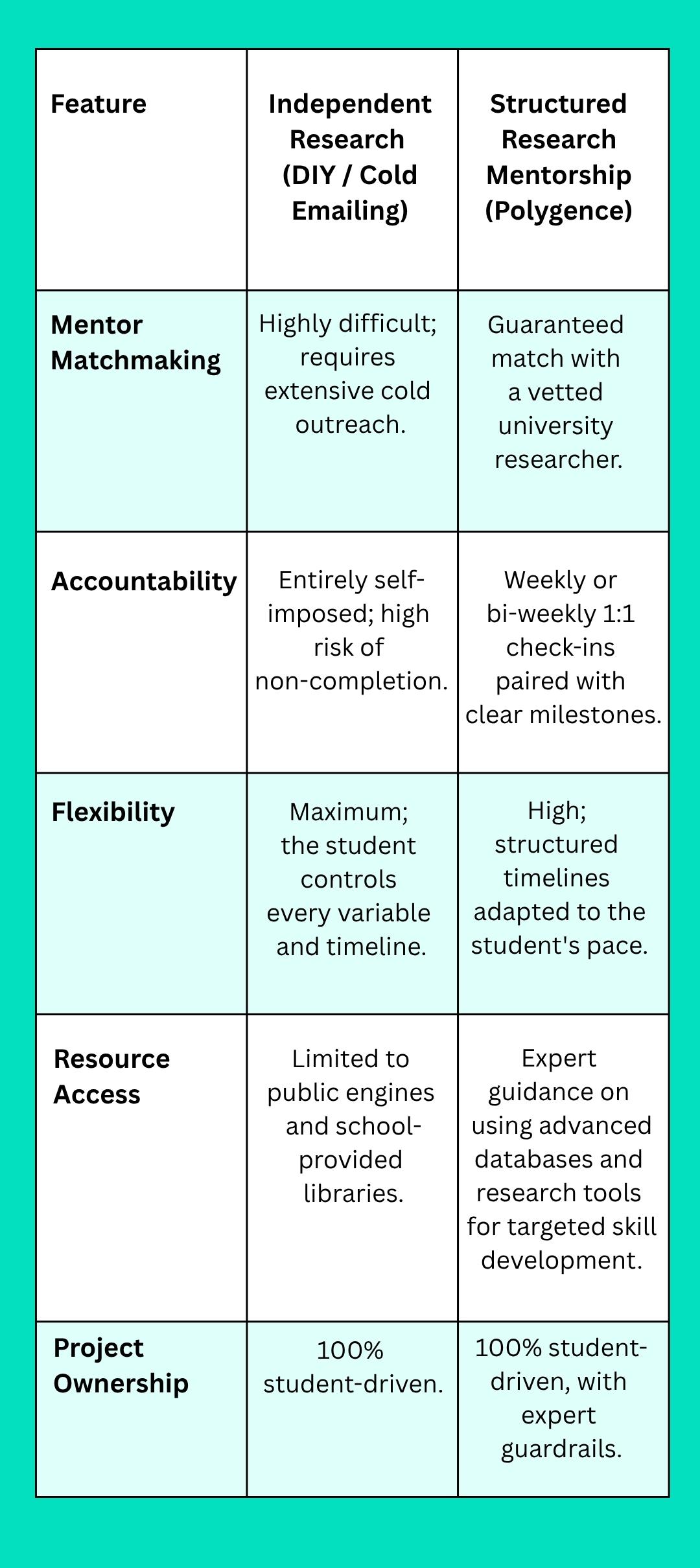
To help visualize how these two pathways diverge in daily practice, let’s look closer at the core pillars of the research experience and journey.
Access to Expert Guidance
In an independent setup, finding an expert mentor can be incredibly difficult. High schoolers looking for an open lab placement are oftentimes competing against university-level undergraduate students. When a student operates entirely without structured support, they run the risk of hitting a conceptual wall—such as getting stuck on a complex statistical model or misunderstanding an advanced genomics paper—with no one to turn to for clarification [1]. Polygence’s core program eliminates this barrier by providing immediate, friction-free access to top-tier academics and industry professionals who love guiding students, ranging in specialties from film studies to environmental science.
Structure and Accountability
Learning how to do research independently requires immense executive functioning. Without deadlines or a calendar of milestones, it is incredibly easy for a passion project to become an unfinished draft sitting on a computer. A structured project-based learning program introduces regular check-ins and external deadlines, transforming a vague, overwhelming goal into a predictable, step-by-step process. This kind of targeted, goal-focused mentoring produces more effective developmental and academic outcomes than unstructured guidance [2]. By anchoring the mentorship in concrete objectives, students are far better equipped to translate big ideas into a finished product.
Flexibility and Project Ownership
Because independent research is entirely self-directed, it offers total freedom. If a student wants to pivot their research question or topic three weeks into the summer, they can do so without consulting anyone. However, a common misconception is that a structured program strips away this autonomy. At Polygence, the student still retains 100% ownership of the idea. The mentor simply acts as a sounding board, helping them refine their scope so the project remains feasible and academically rigorous. Research on adolescent mentoring indicates that this dynamic helps counter the natural dips in motivation by teaching students actionable planning strategies and strengthening their sense of academic confidence [1].
Comparing Outcomes
A common question parents ask is: “Which pathway yields a better final product?”
The truth is that the outcome depends far more on the student's effort, curiosity, and commitment than on the mode they used to get there. Exceptional outcomes are entirely possible through both routes. Through either path, a dedicated student can achieve:
A formal, peer-reviewed journal submission or academic journal publication
A standalone passion project (like building an app, creative writing, or launching a podcast)
A presentation abstract accepted to an academic conference
A competitive submission to regional and national science fairs
The difference lies in the predictability and efficiency of reaching that outcome. An independent student may spend months just trying to format their bibliography correctly or figuring out which journals accept high school submissions. A mentored student can lean on their mentor's industry knowledge to quickly identify the best publication or presentation avenues, allowing them to spend more time on actual intellectual growth and subject-matter mastery.
Comparing Time Investment and Accessibility
Time is a high school student’s most valuable asset. Before choosing a path, families must look realistically at the time investment required before the actual research even begins.
For independent researchers, cold email outreach is a numbers game. It is not uncommon for a student to spend weeks compiling lists of university contacts, drafting highly customized messages, and undergoing dozens of ignored emails or generic rejections before securing a single reply. Studies continue to highlight the low—and perhaps unevenly distributed—response rates from busy faculty members [3,4]. Navigating this process requires around three to six months of lead time, a thick skin, and a massive time commitment just to get a foot in the door to find a mentor pool.
Furthermore, true independent research is heavily dependent on geographic and socioeconomic accessibility. A student living down the street from a major research institution whose parents work in academia will have vastly greater access to independent lab opportunities than a student in a more rural area or school district with minimal research funding. Structured online mentorship democratizes this access, allowing a student anywhere in the world to collaborate with a top-tier researcher or industry expert from their own desk.
Which Students May Thrive With Independent Research?
The DIY approach is a phenomenal fit for a specific type of student. Your child will likely thrive doing independent research if they are:
Self-Motivated: They don't need reminders to open their laptop and work; they naturally spend their free time falling down academic rabbit holes.
Highly Organized: They can manage complex data, track their own deadlines, and break large projects into daily tasks without parental intervention.
Comfortable with Uncertainty: They aren't discouraged by dead ends, unanswered emails, or data that don't make immediate sense.
Well-Networked: They already have a strong local support system, such as a high school teacher willing to supervise lab space or family connections in the scientific community.
Which Students May Benefit From Structured Research Mentorship?
Alternatively, structured programs are designed to unlock the potential of students who have the intellectual capacity for advanced work but need a reliable launchpad to get started. A program like Polygence is ideal for:
First-Time Researchers: Students who have never written a major research paper and need to learn the core methodologies of academic inquiry from scratch.
Students Seeking Accountability: Bright students who tend to procrastinate or get overwhelmed when a project lacks clear boundaries and near-term deadlines.
Highly Specialized Thinkers: A student who wants to explore an incredibly niche topic—like the intersections of fintech and renewable energy—that a generalist teacher may not have the expertise to guide.
Busy Achievers: Students balancing heavy course loads, sports, or music, who need their research time to be highly efficient, productive, and focused on learning rather than logistics.
Experience the Power of Hands-On Learning
🧪 Looking for learning that goes beyond worksheets? Work Lab helps students tackle real-world challenges through applied projects.
Common Misconceptions About Independent and Mentored Research Programs for High School Students
When browsing online forums or attending high school counseling seminars, families often encounter a lot of conflicting advice. Let's debunk a few of the most common myths.
Myth 1: "Independent research is always free."
While sending emails doesn't cost money, the hidden costs of independent research can add up quickly. Depending on the project, families often have to pay for lab safety equipment, premium software and statistical tool licenses, or raw materials for building physical prototypes.
Myth 2: "Admissions officers only value university lab work."
This is a major misconception. Admissions offices don’t award points purely for the prestige of a lab’s name. What they care about is the depth of thinking and how a student articulates what they learned. A rigorous, well-reasoned project will stand out whether it came through a mentorship program or a university lab placement—what matters is the work behind it.
Myth 3: "Research mentorship guarantees publication."
Any program that promises guaranteed acceptance by a reputable journal should be approached with caution. True peer review is an unpredictable process driven by external editorial boards. Proactive, transparent mentorship programs focus on helping students produce high-quality work and identifying appropriate publication outlets. Final acceptance is never an automatic guarantee.
Myth 4: "Structured programs remove student ownership."
Some families worry that a structured program means the mentor does the heavy lifting. In reality, a good mentor never dictates the project—they ask the right questions. The student remains the driving force behind the thesis, the writing, and the conclusions, ensuring the project reflects their authentic voice. The mentor simply provides the professional mirror to ensure the work is rigorous.
Conclusion
Ultimately, choosing between independent research and a structured program like Polygence is not a question of which path is objectively "better." It is a question of matching the right environment to your child's current needs and educational goals.
If your student has an established network, the time to manage cold emailing and the organizational discipline to self-manage a multi-month (or year-long!) project, independent research can be an incredibly rewarding route.
However, if your child wants to eliminate the logistical headaches of cold outreach, secure guaranteed access to a world-class expert, and follow a proven framework that ensures their hard work results in a complete, high-quality project, a structured research mentorship program may be your answer. When making your decision, look past the myths of prestige and focus on where your child will experience the most genuine educational value, skill development, and intellectual growth [2].
Curious to see how a Polygence research project can fit into your child’s busy schedule? Explore our mentor network or connect with our team to learn more about our customizable research offerings!
Citations
Schenk, L., de Meijer, L., & Severiens, S. (2025). Mentoring for motivation: a mixed-method study on a school-based mentoring program for secondary school students. Mentoring & Tutoring: Partnership in Learning, 34(1), 81–99. https://doi.org/10.1080/13611267.2025.2575964
Christensen, K.M., Hagler, M.A., Stams, GJ. et al. Non-Specific versus Targeted Approaches to Youth Mentoring: A Follow-up Meta-analysis. J Youth Adolescence 49, 959–972 (2020). https://doi.org/10.1007/s10964-020-01233-x
Milkman, K. L., Akinola, M., & Chugh, D. (2015). What happens before? A field experiment exploring how pay and representation differentially shape bias on the pathway into organizations. Journal of Business/Applied Psychology, 100(6), 1678–1712.https://doi.org/10.1038/apl0000022
Goldsmith, B., MacKenzie, M., & Wynter, T. (2024). Racial Bias in Academia: An Audit Experiment Revealing Disparities in Faculty Responses to Prospective Students. International Journal of Education Policy and Leadership, 20(1). https://doi.org/10.22230/ijepl.2024v20n1a1401