Work Lab: Career Accelerator Program for College Students

Employers hire people who've done the work. In 6 weeks you'll get trained, work directly with a startup founder on a real project, present it to their team — and walk away with an internship on your resume and a reference you earned.

WHAT IS WORK LAB?

A 6-week career accelerator program with online internship for college students.

Polygence matches you with a startup, non-profit or university innovation hub that has a real problem to solve. You get trained first, then spend six weeks working on the project under the mentorship of your host manager, who is often the founder. You meet 1:1 every week and finish by presenting your work to the company.

It's not a course, not shadowing, and not a project that you submit into the void.

Are you still in high school and interested in internships? Check out Work Lab for High School Students

A REAL WORK LAB PROJECT

Not a brief in your inbox. An online internship with a founder who's mentoring you.

Past project: Designing AI-based online tools to build financial literacy in underserved communities. Here's what six weeks looked like.

WEEK 1

Train

Workplace-readiness training workshop from Polygence, then industry training from your host company.

KICKOFF

Scope

Meet your host manager — often the founder — to agree on the problem, the deliverable and what success looks like.

WEEKS 2-5

Build

Weekly 1:1 check-ins with your host manager, written feedback every week, and async support over Slack, Teams or email.

WEEK 6

Present

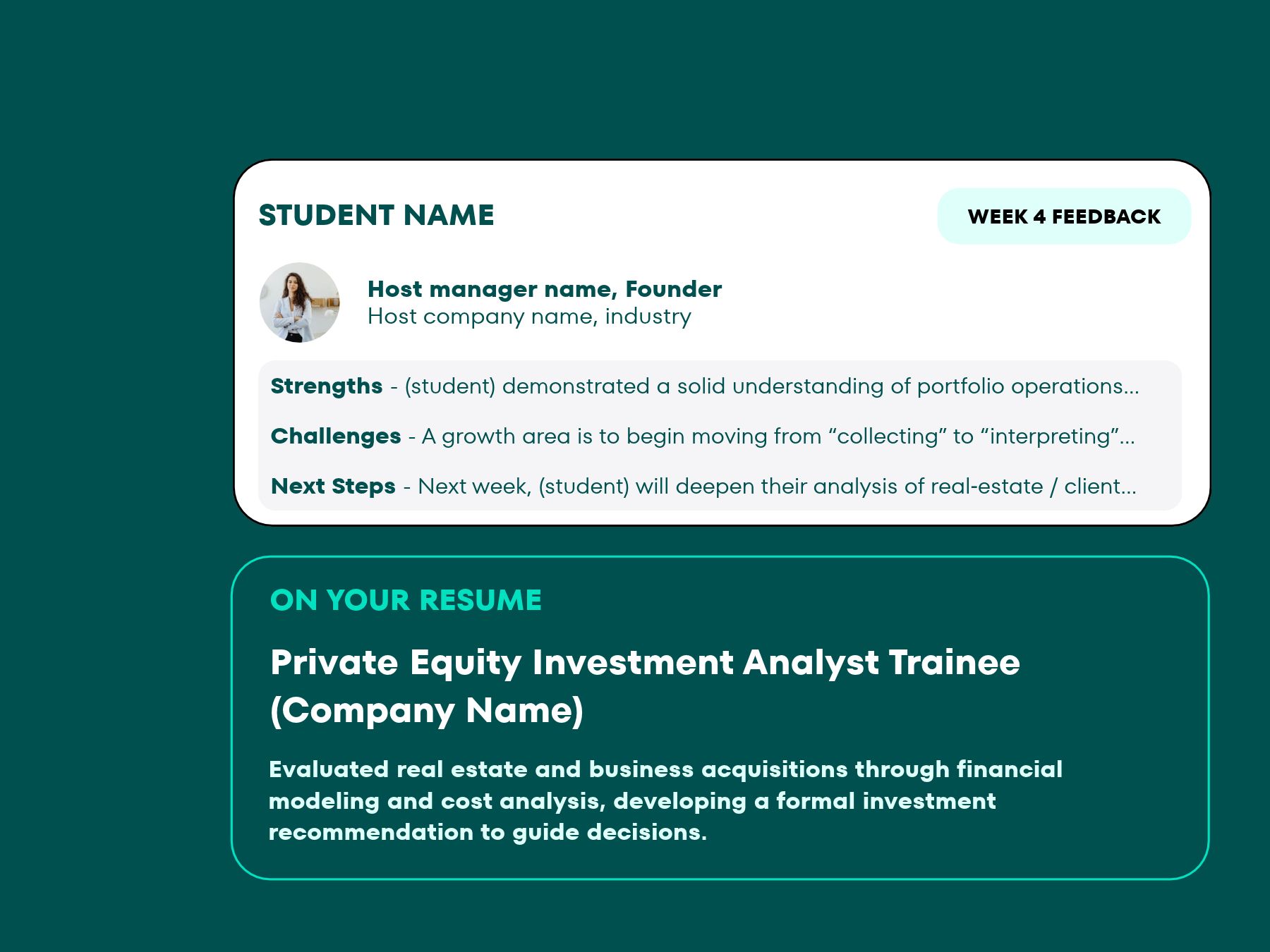
Present your work to the company, get final feedback, and earn a reference if you've performed.

Real students. Real experience to talk about.

“Doing Work Lab the summer before my freshman year of college was a great opportunity to work on real industry problems and learn industry standards before my first day on campus. It’s helped me move forward with other internships and opportunities because I now have real experience I can speak to.”

-Corbin L., aerospace engineering student

“It was a great starter internship. My main contact throughout the internship was really engaged and provided me with the support I needed. Since it was only six-week program and started so early in the summer it was perfect for me because it allowed me to work another paying job the second half of the summer. ”

-Anthony V., engineering & applied sciences

“We’re making a digital plan for one of the company’s partners and working with custom GPTs to help with financial or credit questions. Our work is actually going out there. It’s actually making a real-life impact. Going into college, if I want to expand on that interest, I’ll already have a pretty good baseline to go off of.”

-Akash A., Economics student

Everything a great internship should be. Nothing it shouldn't.

No shadowing. No coffee runs. No busywork.

Face time with founders

Five live 1:1 meetings with your host manager — the people who actually run the company.

Train before you start

Workplace success workshops from Polygence & industry training from your host.

An internship for your resume

List it as a real internship with a real company — not a course, not a certificate.

Written feedback every week

Know exactly where you stand, plus async support from your host on Slack or email.

Present to the company

Finish with a live final presentation — the interview story you'll tell for years.

A reference you earned

Perform well and your host can vouch for you — the thing a portfolio can't give you.
REAL TALK

A project is proof you created something. An internship is the official story.

Entry-level roles ask for experience, and internships ask for… experience. Project platforms can get you a portfolio piece. Work Lab is an online internships program that gets you a person at a real company who knows your work — and can say so.

Self-paced Project PlatformsPolygence Work Lab
TrainingA brief and templatesPolygence workshops + host industry training
Who you work withMentor office hoursThe founder or host manager, 1:1 every week
FeedbackOn final submissionWritten, every week
Finish lineUpload to a portfolioLive presentation to the company
Reference-From your host, when earned
On your resumeA projectAn internship

THE MATH

A year of college: $50,000+.

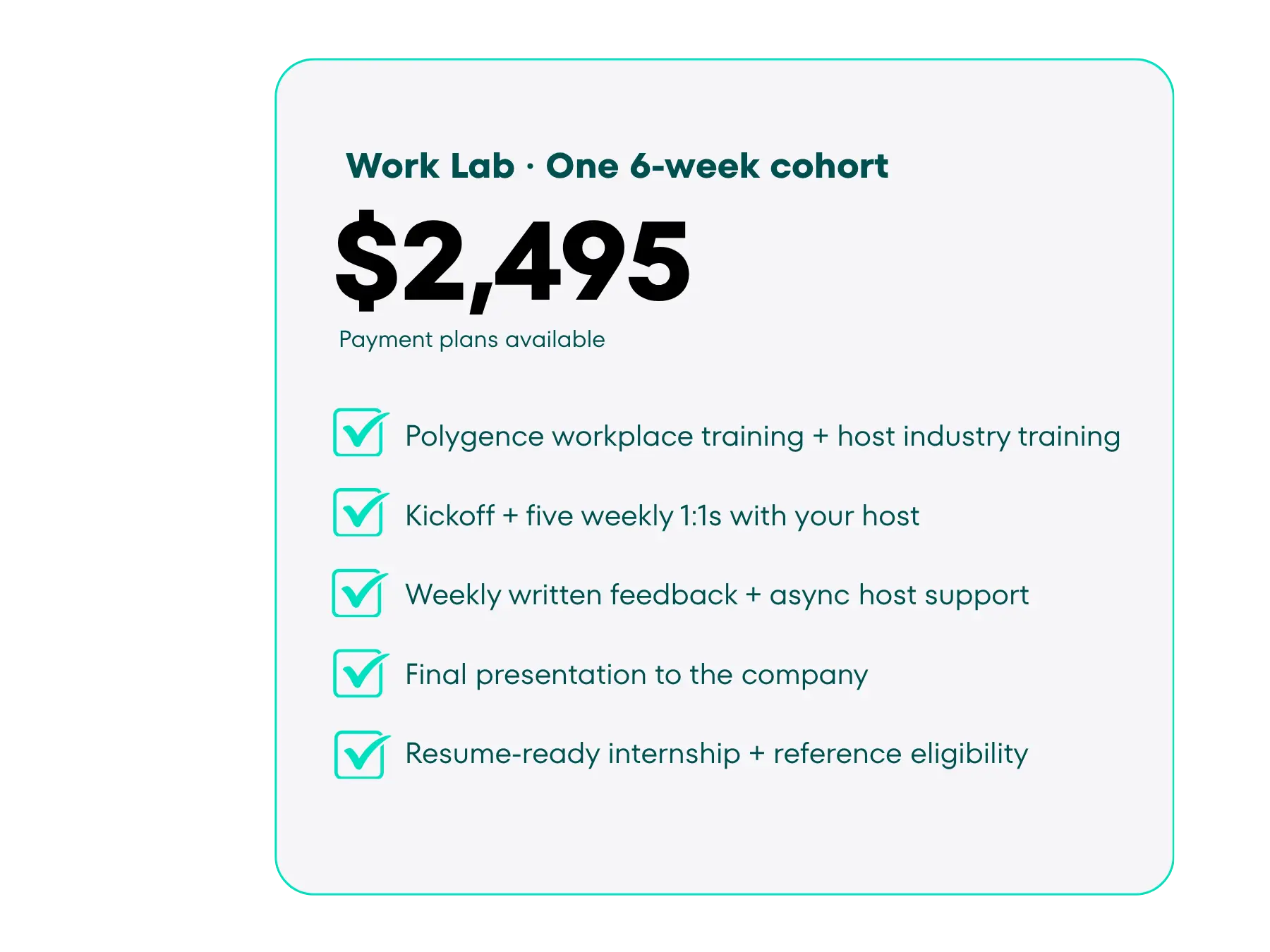
Six weeks that make it count: $2,495.

Your tuition covers what makes Work Lab work: hosts are compensated for their time and mentorship, so you get real attention from people who run companies — not a shared inbox.

Need-based aid may be available. Ask during your application.

Upcoming cohorts · spots are limited by host availability

Final EnrollmentProgram StartProgram End
January 2027December 23January 3February 13
UG Summer I 2027May 15May 23July 2
UG Summer II 2027June 13June 21July 31

Project Format

  • Location: Remote, U.S. Hours

  • Time Commitment: Dedicated training hours and 40 hours of project work, over the course of 6 weeks.

  • Mentorship Structure:

    • Starts with mandatory training sessions: Workplace etiquette with Polygence, then Industry training from the host company.

    • Project work starts with a project kickoff meeting

    • Five weekly check-in meetings with your host company contact

    • Host provides guidance and feedback, but you’ll lead the work

    • Concludes with a final project presentation and direct feedback

Eligibility Requirements

  • University (UG) Work Lab is open to students who will have graduated from high school by the time the Work Lab cohort begins

  • Must be 17 years or older

  • Must be mature, responsible, and self-motivated

  • Must be able to work independently and communicate professionally

  • Some projects require advanced skills like coding

  • This is a selective program for students ready to take initiative and follow through

  • No refunds will be issued for failure to complete the program due to immaturity, lack of follow-through, or unmet host manager expectations

Search illustration
background

Are you up for the challenge? Start your application today.

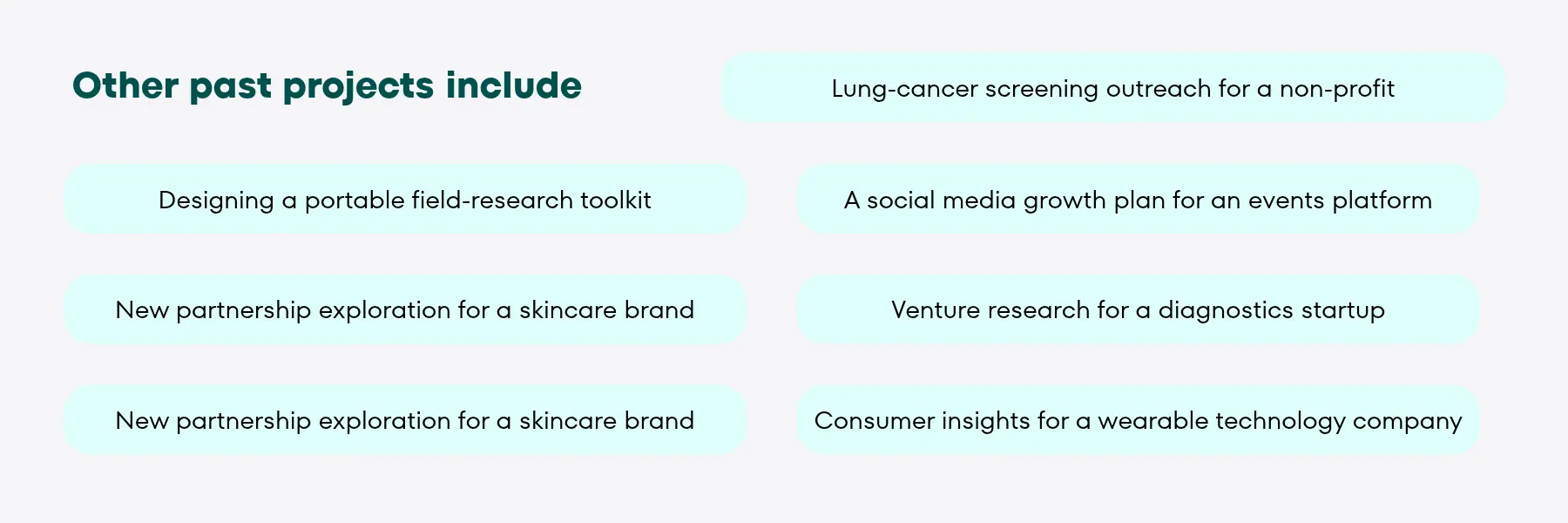
Get Inspired - Past Work Lab Student Projects

Financial Literacy

Designing AI-Based Online Tools to Build Financial Literacy in Underserved Communities

Lung cancer screening

Expanding Lung Cancer Screening Awareness through Community Outreach for a non-profit

Renewable energy toolkit

Building a Portable Field Research Toolkit for a company

Skincare research and outreach

Exploring new connections for a cutting-edge skincare company

Healthcare data

Improving Healthcare Accuracy by Automating Data Extraction for Doctors

Social media presence

Build the Social Media presence of an innovative social event platform

Work Lab FAQs

1. Does Work Lab count as a real internship?
Yes — you do real project work for a real organization, meet weekly with your host manager and present to their team. You can list it on your resume as an internship.

2. How do students get hands-on experience in the program?
Students start with training from their host company, then move straight into project work. You will use real tools, work on real problems, and contribute to something the company actually needs. The focus is on doing the work, not watching someone else do it.

3. How much time does it take?
5–10 hours of training, then about 40 hours of project work, spread over six weeks, on your own schedule — plus one live check-in a week that you schedule directly with your host manager. Flexible scheduling means you can balance Work Lab with other commitments.

4. Do students need prior experience to join?
No. Many projects are designed for students who are starting from scratch. You will get training before the project begins. Some projects do require specific skills, like coding, but many are open to students who are ready to learn and take the work seriously.

5. Who can enroll in Work Lab?
University Work Lab is available to students who have graduated from high school and are 17 years or older.

6. Why does Work Lab cost more than a project subscription?
Because people are involved. Hosts are compensated for weekly mentorship and feedback, and you get structured training, a live presentation and a shot at a reference.